


Chronic bloating can turn an ordinary day into a logistical puzzle. Clothes feel uncomfortable, meals become stressful, and you may start wondering whether every bite is working against you.
Gluten often lands near the top of the suspect list. But before you remove it from your diet, there is an important question to consider: Could celiac disease be part of the picture?
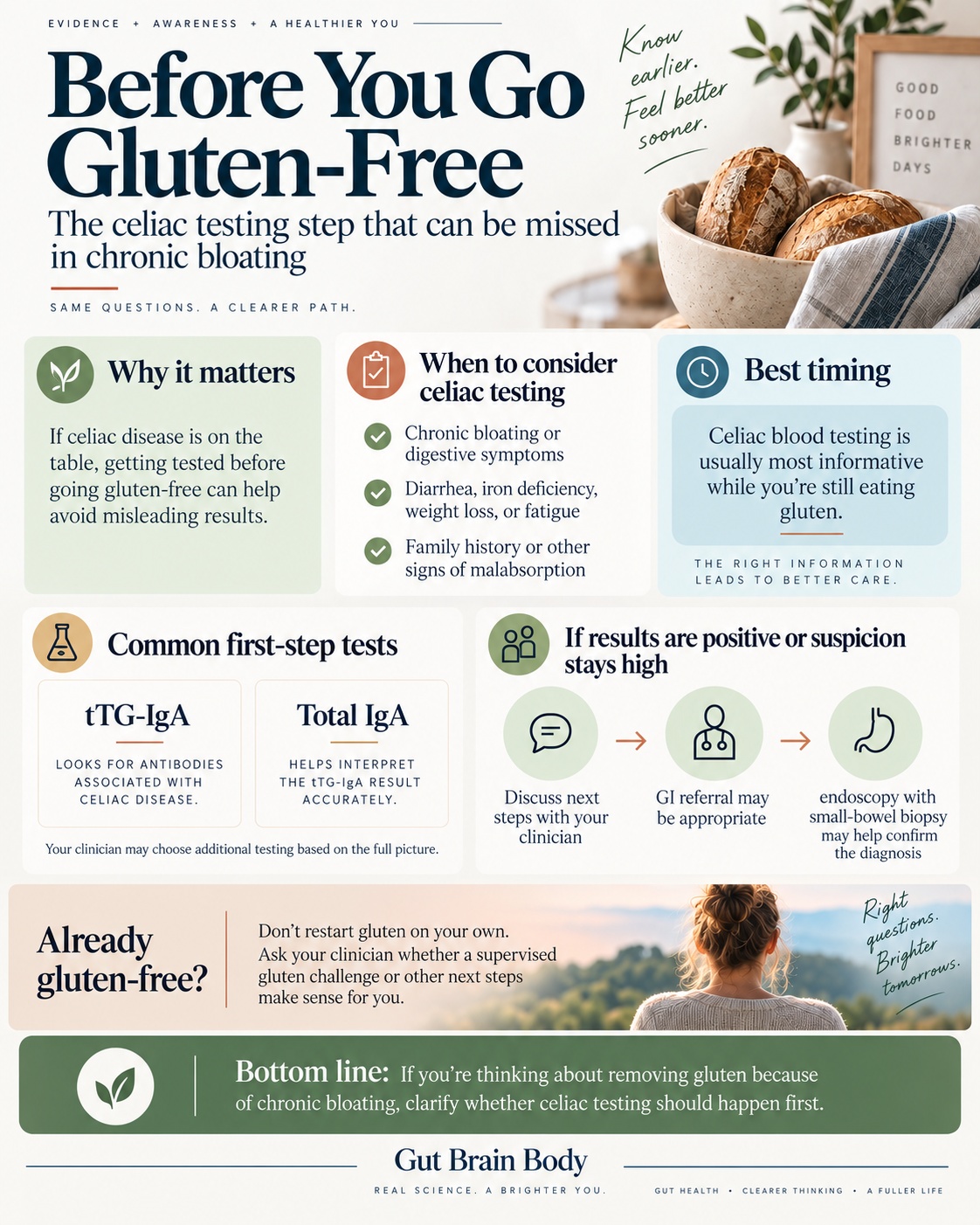
Bloating alone does not mean you have celiac disease. It is a common symptom with many possible gastrointestinal and non-gastrointestinal explanations. However, chronic bloating can be a reason to discuss celiac testing, particularly when it occurs with diarrhea, iron-deficiency anemia, unintentional weight loss, a family history of celiac disease, or other signs of poor nutrient absorption.[1]
The timing of that conversation matters. Starting a gluten-free diet before completing appropriate testing can make the results harder to interpret.
What Is Celiac Testing Designed to Clarify?
Evaluating someone for celiac disease usually involves more than looking at symptoms.
Bloating is not a celiac “fingerprint.” It may raise the question, but it cannot answer it. Think of bloating as a dashboard warning light: It tells you something deserves attention, but it does not identify the exact problem under the hood.
Clinicians generally consider your symptoms, dietary gluten intake, blood-test results, total IgA level, and sometimes findings from small-intestinal biopsies.[1,2] Each piece provides different information.
This distinction matters because it is easy to feel better after changing several foods and assume you have found the diagnosis. Your experience is real, but symptom improvement alone does not establish celiac disease. Formal testing can help distinguish a suspected connection from a confirmed diagnosis.
When Symptoms May Warrant Celiac Testing
Chronic symptoms like persistent diarrhea, bloating, abdominal pain, fatigue, and unexplained weight loss can justify discussing celiac testing, but the likelihood of finding celiac disease depends heavily on the rest of your clinical picture.
Testing may be more compelling when symptoms occurs alongside:
- Chronic diarrhea
- Iron-deficiency anemia
- Unintentional weight loss
- A family history of celiac disease
- Osteoporosis or other bone disease
- Abnormal liver tests
- Other signs of malabsorption or poor nutrient absorption[1]
You do not need to decide on your own whether your symptoms “count.” A clinician can help assess how your symptoms, health history, family history, and diet affect the likelihood of celiac disease.
At the same time, celiac disease should not become the automatic explanation for every swollen or uncomfortable abdomen. GI symptoms can occur in many digestive and non-digestive conditions. A thoughtful evaluation leaves room for other contributors rather than forcing every symptom into one box.
For more information about broader digestive concerns, Gut Brain Body’s Gut Health and Digestive Issues page outlines the types of symptoms that may warrant a more complete nutrition and health review.
Why Celiac Testing Should Usually Happen Before Going Gluten-Free
If celiac disease is being considered, testing is most informative while you are still eating gluten.
Avoiding or substantially reducing gluten can lower celiac antibody levels and allow intestinal changes to improve. This may cause later blood tests or biopsies to provide less useful information.[1,2]
In other words, removing gluten before testing can be a bit like cleaning up the scene before the investigator arrives. You may feel that you are taking action, but you can also remove some of the evidence needed to understand what was happening.
If medically safe and tolerated, it is usually best to arrange celiac testing before beginning a gluten-free diet. Make that plan with a qualified clinician rather than trying to design your own testing strategy.
What If You Have Already Stopped Eating Gluten?
Do not independently restart gluten simply because you read that testing works better during gluten consumption.
The ideal amount and duration of gluten exposure before repeat testing are not uniformly established. Suggested gluten-challenge protocols differ, and the right approach depends on your history, symptoms, prior results, and ability to tolerate gluten.[1,2]
Instead, tell your clinician:
- How long you have limited or avoided gluten
- How strict that restriction has been
- Whether your symptoms changed
- Whether you previously had celiac blood tests or an endoscopy
- Whether you have access to the original laboratory or pathology results
This information can help determine which next steps are reasonable and whether a supervised gluten challenge, genetic testing, or another strategy should be considered.

Blood Tests Commonly Used for Celiac Disease
For adults who are eating gluten, clinicians commonly begin with two blood tests:
- Tissue transglutaminase IgA, usually abbreviated as tTG-IgA
- Total serum IgA[1]
The tTG-IgA test looks for an antibody pattern associated with celiac disease. It is the preferred first-line blood test in many guidelines, but no blood test is perfect. Its accuracy can vary depending on the assay, testing threshold, clinical setting, and whether the person has been consuming enough gluten.[1,3]
Results should not be interpreted as an isolated yes-or-no answer. Gluten intake, total IgA, symptoms, and sometimes biopsy findings all affect what the result means.
Why Total IgA Matters
Total IgA helps the clinician determine whether an IgA-based test can be interpreted normally.
Some people have IgA deficiency. In that situation, a tTG-IgA result may be negative even when celiac disease is present. A low or absent total IgA does not diagnose celiac disease, but it can change which antibody tests are appropriate.[1,2]
When IgA deficiency is confirmed, a clinician may consider IgG-based celiac tests instead. These tests can be useful, although their diagnostic accuracy is less certain. If symptoms strongly suggest malabsorption, a negative IgG-based result may not completely settle the question.[1,2]
This is why ordering tTG-IgA without considering total IgA can leave an important blind spot.
What Happens After a Positive Celiac Blood Test?
In U.S. adult practice, a positive celiac blood test commonly leads to referral for an upper endoscopy with small-intestinal biopsies to confirm the diagnosis.[1]
“Commonly” is the key word. It is not an automatic pathway for every person in every setting. The next step may depend on factors such as:
- Age
- Antibody concentration
- Symptoms and clinical history
- Other laboratory findings
- The particular test and assay used
- Regional guidelines
- Specialist judgment
During an upper endoscopy, a specialist can collect several samples from the duodenum, the first portion of the small intestine. Multiple samples are used rather than relying on a single piece of tissue because celiac-related changes may not be distributed evenly.[1]
Bloodwork and biopsy findings are then interpreted alongside your symptoms and gluten intake. The goal is not simply to collect more tests. It is to make the diagnosis as reliable as possible before you commit to a major long-term dietary change.
Does a Negative Celiac Blood Test Rule Out Celiac Disease?
A negative celiac blood test can be reassuring, but it does not fully exclude celiac disease in every situation.
The result may be less conclusive when:
- You were eating little or no gluten before testing
- Total IgA was low or was not checked
- The initial testing was incomplete
- Your symptoms or other findings strongly suggest malabsorption[1,2]
That does not mean everyone with bloating and negative bloodwork needs an endoscopy. Most people should not assume that one negative test is “wrong” and begin pursuing increasingly invasive procedures.
Instead, the next step should reflect the entire situation. A clinician may review your gluten intake, confirm which tests were ordered, look at the actual values rather than only the “positive” or “negative” label, and consider whether another explanation better fits your symptoms.
Tests do not operate independently of the person being tested. The same result may carry different meaning in someone with several signs of malabsorption than in someone with bloating alone.
Where Genetic Testing Fits in Celiac Evaluation
Genetic testing for HLA-DQ2 or HLA-DQ8 is not usually the first test used to investigate celiac disease.[1,2]
It may be helpful in selected uncertain cases, particularly when someone has already restricted gluten or has conflicting blood-test and biopsy findings.
The value of this test is mainly in what a negative result can tell you. If the celiac-associated HLA types are absent, celiac disease becomes very unlikely. However, a positive result does not prove that you have celiac disease because these HLA types are common in the general population.[1,2]
You can think of the genes as an admission ticket, not proof that you attended the event. They may make celiac disease possible, but they do not confirm that it is present.
For that reason, consumer genetic results or an isolated positive HLA test should not be treated as a diagnosis.
What Research Says About Celiac Test Accuracy
Research supports tTG-IgA as an effective first-line blood test, but its performance is not identical in every patient or laboratory.
A 2022 systematic review and meta-analysis found that celiac serology can be diagnostically useful while also showing variation across assays, testing thresholds, patient groups, and reference standards.[3] Much of the evidence came from secondary-care populations, where the likelihood of celiac disease may be higher than it is in general primary care.
This is why a single pooled sensitivity or specificity number should not be treated as a universal guarantee.
The practical takeaway is simpler: tTG-IgA is useful, but context matters. A result is most meaningful when the clinician also knows whether you were eating gluten, whether your total IgA was adequate, what symptoms or risk factors led to testing, and whether further evaluation is warranted.[1–3]
What to Discuss With Your Healthcare Team
If chronic bloating has you wondering about celiac disease, you do not need to arrive at your appointment with the diagnosis already solved. You do, however, want to share the information that makes a useful evaluation possible.
1. Whether Celiac Testing Makes Sense for You
Mention any diarrhea, iron-deficiency anemia, unintended weight loss, family history of celiac disease, bone disease, abnormal liver tests, or other signs of poor nutrient absorption.[1]
2. How Much Gluten You Currently Eat
Be specific. “I eat some gluten” can mean anything from bread at every meal to one cracker last Tuesday. Your usual intake matters when the clinician interprets testing.
3. Whether You Plan to Go Gluten-Free
If celiac disease is a possibility, try to arrange testing before substantially reducing gluten, provided continuing it is medically safe and tolerated.[1,2]
4. Whether Total IgA Will Be Checked
For an adult eating gluten, tTG-IgA plus total IgA is a common initial approach.[1] Testing may differ for someone with known IgA deficiency or for a person who has already adopted a gluten-free diet.
5. What Positive or Negative Results Would Mean
Ask what the next step would be after each possible result. A positive test may lead to specialist referral and endoscopy, while a negative test may need closer review if your gluten intake was low or signs of malabsorption remain concerning.[1,2]
6. Whether Genetic Testing Would Add Useful Information
HLA-DQ2/DQ8 testing may help in selected uncertain cases, but a positive result cannot diagnose celiac disease.[1,2]
When to Seek Medical Care for Chronic Bloating
Consider speaking with a qualified healthcare professional if bloating is persistent, disruptive, or repeatedly affects your food choices.
A medical evaluation becomes especially important when bloating occurs with:
- Chronic diarrhea
- Iron-deficiency anemia
- Unintentional weight loss
- A family history of celiac disease
- Osteoporosis or other bone disease
- Abnormal liver tests
- Other signs that nutrients may not be absorbed properly[1]
If you have already eliminated gluten, let your clinician know before making additional changes. Do not independently restart gluten or attempt a gluten challenge without guidance. The appropriate strategy depends on your prior testing, current diet, symptoms, and medical circumstances.
The Bottom Line on Celiac Testing and Bloating
Chronic bloating does not diagnose celiac disease, but it can be a reason to discuss testing—especially when other risk factors or signs of malabsorption are present.
If celiac disease is being considered, the best time to plan testing is generally before you begin a gluten-free diet, as long as continuing gluten is medically safe and tolerated. In adults eating gluten, tTG-IgA and total IgA are common initial blood tests. Positive results often lead to specialist evaluation and small-intestinal biopsies in U.S. practice, while negative results may require a closer look when gluten intake was low, IgA deficiency is present, or clinical concern remains high.
Most importantly, do not assume that gluten must explain everything. Your symptoms deserve a careful evaluation that considers the broader picture.
Gut Brain Body can help you examine digestive symptoms, dietary patterns, and the wider gut-brain-body connection without assuming that one food or exposure is automatically responsible. Learn more about Functional Nutrition Services or schedule a consultation with Thomas Prather, CNS, LDN.
Frequently Asked Questions
Can chronic bloating be a sign of celiac disease?
Chronic bloating can occur with celiac disease, but bloating alone does not diagnose it. Testing may be more appropriate when bloating occurs with diarrhea, iron-deficiency anemia, weight loss, a family history of celiac disease, or other signs of malabsorption.[1]
Should I stop eating gluten before a celiac blood test?
If celiac disease is being considered, testing is generally most informative while you are still eating gluten, provided doing so is medically safe and tolerated. Reducing or avoiding gluten can make blood tests and biopsies harder to interpret.[1,2]
What blood tests are commonly used for celiac disease?
For adults who are eating gluten, clinicians commonly begin with tissue transglutaminase IgA, or tTG-IgA, along with total serum IgA.[1]
Why is total IgA checked with a tTG-IgA test?
Some people have IgA deficiency, which can make an IgA-based celiac test appear negative even when celiac disease is present. Total IgA helps determine whether tTG-IgA can be interpreted normally.[1,2]
Does a positive genetic test mean I have celiac disease?
No. A positive HLA-DQ2 or HLA-DQ8 result does not diagnose celiac disease because these HLA types are common. A negative result can be more useful because it makes celiac disease very unlikely.[1,2]
This article is for educational purposes only and is not a substitute for individualized medical or nutrition advice. Speak with an appropriately qualified healthcare professional before making significant changes to your diet, supplements or treatment plan.
References
1. Rubio-Tapia A, Hill ID, Semrad C, et al. American College of Gastroenterology Guidelines Update: Diagnosis and Management of Celiac Disease. American Journal of Gastroenterology. 2023;118(1):59–76. https://doi.org/10.14309/ajg.0000000000002075
2. Husby S, Murray JA, Katzka DA. AGA Clinical Practice Update on Diagnosis and Monitoring of Celiac Disease: Changing Utility of Serology and Histologic Measures—Expert Review. Gastroenterology. 2019;156(4):885–889. https://doi.org/10.1053/j.gastro.2018.12.010
3. Sheppard AL, Elwenspoek MMC, Scott LJ, et al. Systematic review with meta-analysis: the accuracy of serological tests to support the diagnosis of coeliac disease. Alimentary Pharmacology & Therapeutics. 2022;55(5):514–527. https://doi.org/10.1111/apt.16729