


If you have been told to drink more water, eat more fiber, exercise, and “give it time”—yet chronic constipation keeps returning, you are not failing at the basics.
Those foundational habits can matter. But persistent constipation is not always a simple fiber-and-water problem. Sometimes the more useful question is:
What is actually getting in the way of a complete, comfortable bowel movement?
For some people, stool moves slowly through the colon. For others, stool reaches the rectum but is difficult to evacuate because the pelvic-floor muscles are not coordinating well. Medications, supplements, thyroid or metabolic factors, low food intake, restrictive eating, pain, stress, sleep disruption, and other health conditions can also change the picture.
Many people have a mixed pattern. When constipation persists, the goal should not automatically be “more fiber.” The goal is to understand the pattern well enough to choose a next step that fits your physiology.
Chronic constipation is about more than how often you go
Many people think constipation only means having fewer than three bowel movements per week. Frequency matters, but it is not the entire story.
You can have a bowel movement every day and still be constipated if you are experiencing:
- Hard, dry, or pellet-like stool
- Significant straining
- A sensation of blockage
- Feeling incompletely emptied afterward
- Spending a long time on the toilet
- Needing to change position, press around the rectum or vagina, or use manual assistance
- Bloating, abdominal discomfort, or a persistent “backed up” feeling
This is why it is important to understand not just how often you go, but what the process is like.
Does stool feel hard because it may have been sitting in the colon for a long time? Does it feel like it is right there but will not come out? Did symptoms begin after a medication change, illness, surgery, major stressor, dietary restriction, travel, pregnancy, hormonal transition, or period of lower food intake?
The timeline often provides useful clues.
For additional support with digestive symptoms, explore Gut Brain Body’s Gut Health and Digestive Issues services.
What causes chronic constipation?
Chronic constipation may involve delayed movement through the colon, difficulty evacuating stool from the rectum, medication effects, medical conditions, nutritional factors, or several contributors at once.
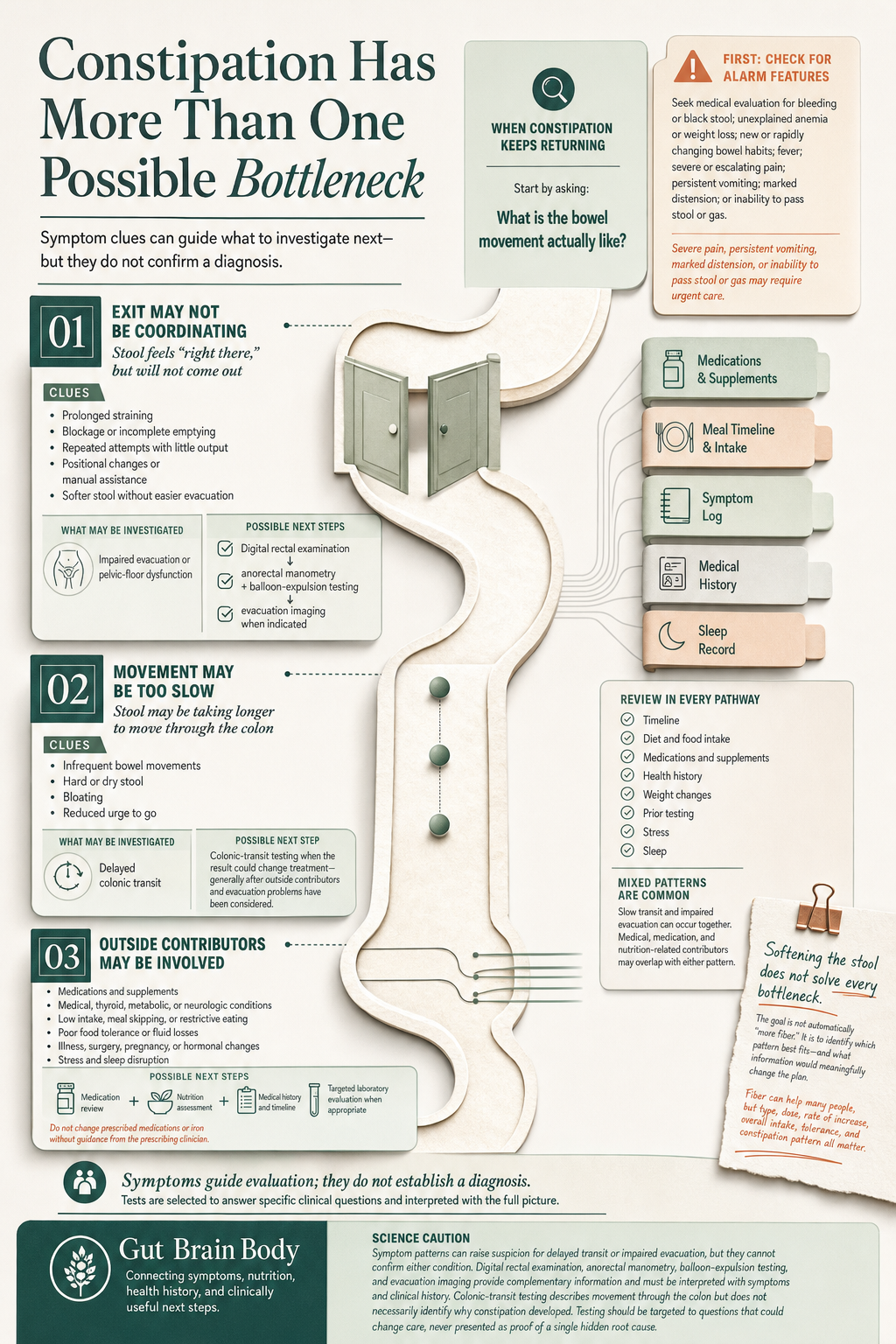
Three patterns are especially important to consider:
- Impaired evacuation or pelvic-floor dysfunction
- Delayed colonic transit
- Secondary constipation related to medications, supplements, health conditions, or food intake
1. Difficulty evacuating stool: a possible defecatory disorder
A defecatory disorder occurs when the muscles and pressure patterns needed to evacuate stool are not working in a coordinated way.
Think of it like trying to push a door open while someone is unknowingly pulling it shut. The colon may be moving stool toward the exit, but the pelvic-floor and anal muscles may not be relaxing appropriately when you need them to.
Symptoms that can raise suspicion include:
- Prolonged straining
- A sense of blockage at the rectum
- Incomplete evacuation
- Needing positional changes or manual maneuvers
- Repeated trips to the bathroom with little output
- Feeling that laxatives soften stool but do not solve the “stuck” sensation
Symptoms alone cannot diagnose a defecatory disorder. However, these symptoms are important enough to change the evaluation pathway.
Formal assessment commonly includes anorectal manometry and a balloon-expulsion test. These tests examine pressure patterns, rectal sensation, muscle relaxation, and the ability to expel a small balloon from the rectum. Defecography or other evacuation imaging may be useful when results are inconclusive or a structural concern is present. [1]
A careful digital rectal examination can also provide meaningful information, especially when the clinician assesses pelvic-floor movement during simulated evacuation. A normal examination does not completely rule out a defecatory disorder, but it can help determine whether specialized testing is warranted. [1]
If dyssynergic defecation is confirmed, constipation-focused pelvic-floor biofeedback is generally the best-supported first-line treatment. This is different from simply doing Kegels. The goal is to practice coordinated abdominal pressure, pelvic-floor relaxation, anal relaxation, and more effective evacuation. [2]
2. Delayed colonic transit: when stool moves too slowly
Slow-transit constipation means stool is moving more slowly than expected through the colon.
Hard stool, infrequent bowel movements, bloating, and a reduced urge to go can raise suspicion for delayed transit. However, symptoms and Bristol stool type cannot prove slow transit or rule out a coexisting evacuation problem. [3]
This distinction matters because someone can have slow transit, impaired evacuation, or both. Focusing on only one part of the pattern can leave treatment frustratingly incomplete.
When the answer would influence care, a colonic-transit study can show whether material is moving unusually slowly through the colon. It is generally most useful after secondary contributors and possible evacuation disorders have been considered, particularly when the result could affect medication choices, referral decisions, or more advanced treatment. [1]
Transit testing does not necessarily identify why constipation developed. It provides information about the pattern—whether movement through the colon appears delayed and where material may be accumulating.

3. Secondary constipation: medications, supplements, health conditions, and intake
Constipation is often influenced by factors outside the colon itself.
A comprehensive review should include medications and supplements. Common contributors include:
- Opioid pain medications
- Anticholinergic medications
- Tricyclic antidepressants
- Some antipsychotic medications
- Calcium-channel blockers
- Iron supplements
- Calcium-containing supplements
- Aluminum-containing antacids [4]
This does not mean a medication is “bad” or should automatically be stopped. It means the benefit-risk balance, formulation, timing, dose, or bowel-support strategy may need to be revisited with the prescribing clinician.
Do not stop, reduce, or switch a prescribed medication or iron supplement without guidance from the clinician who prescribed it.
Food intake also matters. Low overall intake, meal skipping, restrictive eating, nausea, fear of symptoms, food insecurity, and unintentional under-fueling can affect bowel function. Lower intake may reduce stool volume and regular meal-related stimulation of the digestive tract.
This is not about blaming someone for “not eating enough.” It is about asking whether appetite, food tolerance, weight change, pain, stress, body-image concerns, or fear of symptoms may be influencing intake in a way that deserves support.
Why more fiber may not fix chronic constipation
Fiber can be helpful, but it is not universally helpful in the same way for every constipation pattern.
Fiber supplements improve constipation outcomes on average, and psyllium has one of the stronger evidence bases among commonly used fiber supplements. At the same time, some people experience gas, bloating, cramping, or worsening discomfort—particularly when fiber is increased too quickly or when delayed transit or impaired evacuation is part of the picture. [5,6]
If you have tried fiber and felt worse, that does not automatically mean fiber is “bad” for you. It may mean better questions are needed:
- Which type of fiber did you use?
- How much did you take?
- How quickly did you increase it?
- Did it change stool consistency without improving evacuation?
- Did it worsen pressure, bloating, or pain?
- Were you eating enough overall?
- Was a medication or supplement working against the plan?
- Could pelvic-floor dysfunction or slow transit be present?
Fiber should be personalized—not endlessly escalated.
Hydration also matters, especially when increasing fiber or when illness, heat exposure, sweating, diarrhea, or diuretic medication raises the risk of dehydration. However, substantially increasing water intake has not been shown to reliably resolve chronic constipation in adults who are already adequately hydrated. [7]
People with heart failure, kidney disease, electrolyte concerns, or a prescribed fluid restriction should follow individualized medical guidance rather than generic advice to drink very large amounts of water.
Movement is valuable for overall health and may support bowel regularity for some people. But persistent constipation should not be treated as proof that you are not exercising enough. Exercise can be a supportive strategy without replacing evaluation of the underlying constipation pattern. [8]
Food-based approaches that may be worth considering
When appropriate, practical food strategies may be easier to evaluate than an overly complicated supplement plan.
Small trials and systematic reviews suggest that certain foods or beverages may help some adults with constipation, including:
- Kiwifruit
- Rye bread
- Certain mineral waters, including magnesium-rich waters studied for constipation [9]
These are not universal prescriptions. They are options that may fit particular people depending on tolerance, medical history, dietary needs, and the likely constipation pattern.
- Kiwifruit may be a reasonable food-first option for some people, but allergy history matters, including possible latex-fruit cross-reactivity.
- Rye bread contains gluten and is not appropriate for people with celiac disease. People undergoing evaluation for celiac disease should discuss gluten intake with their clinician rather than independently starting or stopping gluten.
- Mineral water may be useful in selected cases, but mineral content varies. It should not be treated as universally appropriate for people with kidney disease, electrolyte disorders, or medically required mineral restrictions.
The key is to test one meaningful change at a time and observe what happens to stool frequency, stool form, urgency, bloating, discomfort, ease of evacuation, and overall tolerance.
What should a comprehensive constipation evaluation include?
A good constipation assessment is not just a checklist of laxatives tried.
A comprehensive evaluation may consider:
- When symptoms began and what changed beforehand
- Stool frequency, stool form, straining, urgency, and incomplete evacuation
- Whether symptoms suggest delayed movement, outlet difficulty, or both
- Prior gastrointestinal testing, imaging, colonoscopy history, and relevant laboratory work
- Medication and supplement use
- Food intake, appetite, meal timing, food tolerance, and restrictive eating patterns
- Weight changes and signs of nutritional decline
- Hydration patterns and sources of fluid loss
- Sleep quality, stress load, pain, and autonomic arousal
- Activity level, without assuming activity is the cause
- Hormonal, metabolic, neurologic, and pelvic health history
- Symptoms that occur together, such as bloating, reflux, nausea, fatigue, pelvic pain, urinary symptoms, or menstrual changes
Routine medical evaluation may appropriately rule out major disease, yet a person can still be left with persistent symptoms and no useful plan beyond “eat more fiber.”
That is where a detailed clinical nutrition lens can help—not by dismissing conventional care, but by organizing the remaining questions:
- What has already been ruled out?
- What remains plausible?
- Which symptoms tend to travel together?
- What information would actually change the next step?
- Would targeted testing, a medication review, pelvic-floor evaluation, nutrition support, or a different treatment strategy be useful?
A functional nutrition approach considers the interaction among symptoms, dietary patterns, medications, lifestyle, laboratory data, medical history, and personal context. Learn more in the Functional Nutrition overview.
What testing can add when the constipation pattern is unclear
Testing is most useful when it answers a defined clinical question and could reasonably change the plan.
For persistent constipation involving straining, blockage, incomplete evacuation, or manual maneuvers—especially when standard measures have not been sufficient—anorectal manometry and balloon-expulsion testing can help evaluate whether impaired evacuation is contributing. These tests provide complementary information, but neither should be treated as a stand-alone diagnosis. Results are interpreted alongside symptoms, examination findings, and sometimes evacuation imaging. [11]
For suspected slow transit, colonic-transit testing can add useful information after secondary contributors and evacuation disorders have been considered or addressed. [1]
Depending on the history, a clinician may also consider targeted laboratory evaluation for endocrine, metabolic, inflammatory, nutritional, or electrolyte concerns. The goal is not to order every possible test. It is to choose tests that could meaningfully change nutrition strategy, medical referral, treatment, monitoring, or follow-up.
There is growing interest in the microbiome, bile-acid signaling, autonomic regulation, and gut-brain communication. These are meaningful areas of research and may provide context in specialty settings. However, current commercial microbiome reports should not be used alone to diagnose the cause of an individual’s constipation or automatically select a probiotic, supplement, or restrictive diet. Results require interpretation within the person’s symptoms, medical history, diet, medications, and established clinical evaluation. [12]
Supportive strategies while you investigate the pattern
While pursuing medical evaluation or specialty testing, several generally low-risk strategies may support bowel function:
- Use a consistent toileting window, often after a meal when the gastrocolic reflex is more active.
- Consider a supported footstool position if it makes evacuation more comfortable.
- Avoid repeated, prolonged straining.
- Track stool form, frequency, effort, incomplete evacuation, food intake, hydration, sleep, and medication changes.
- Increase fiber gradually rather than aggressively, especially if bloating or pressure is significant.
- Pursue constipation-focused pelvic-floor rehabilitation when symptoms and testing support outlet dysfunction.
- Use stress reduction, breathing, pain management, and sleep support as adjunctive care—not as substitutes for appropriate medical evaluation.
Making a supported toileting position practical
Some people find that elevating the feet while sitting on the toilet creates a more comfortable position for evacuation. A footstool should feel stable, fit securely around or in front of the toilet, and allow you to rest your feet without forcing an uncomfortable hip, knee, or back position. The goal is not to strain harder, but to see whether a supported posture makes it easier to relax and use gentle abdominal pressure.
If you want a purpose-built option, the Squatty Potty Original Toilet Stool is one practical example designed to fit around a standard toilet. As an Amazon Associate I earn from qualifying purchases. A toileting stool is not a treatment for slow transit, pelvic-floor dysfunction, or another medical cause of constipation, and it should not replace evaluation when symptoms persist.
Whichever support you use, avoid prolonged sitting or repeated forceful straining. If changing position does not help—or if stool consistently feels blocked despite being soft—discussing the pattern with a clinician or pelvic-floor specialist may be more useful than continuing to adjust posture on your own.
Stress, poor sleep, pain, and heightened autonomic arousal can influence gut-brain signaling and pelvic-floor tension in some people. These factors may be meaningful contributors, but they should not be used to explain away persistent constipation or replace evaluation for medication effects, structural disease, endocrine factors, transit delay, or defecatory disorders.
When should constipation be medically evaluated?
Constipation deserves timely medical attention when there is:
- Rectal bleeding or black stool
- Unexplained anemia
- Unintentional weight loss
- New or rapidly changing bowel habits
- Severe or escalating abdominal pain
- Persistent vomiting
- Fever
- Inability to pass stool or gas with significant abdominal distension
- A family or personal history that raises concern for colorectal cancer or inflammatory bowel disease
- New constipation later in life without a clear explanation
Seek urgent medical care for severe abdominal pain, persistent vomiting, marked abdominal distension, or inability to pass stool or gas, particularly when symptoms are worsening.
Constipation alone does not automatically require colonoscopy when colorectal cancer screening is current and there are no alarm features. However, bleeding, anemia, weight loss, concerning examination findings, abnormal screening history, or a significant change in symptoms should be evaluated medically. [1,13]
The bottom line: chronic constipation requires pattern recognition
Chronic constipation is often more complicated than “not enough fiber.”
The most useful next step is often determining whether the primary issue is:
- Stool consistency and dietary pattern
- Delayed colonic transit
- Impaired evacuation or pelvic-floor dyssynergia
- A medication, supplement, or medical contributor
- Low intake, restrictive eating, or poor food tolerance
- A mixed presentation
You deserve an approach that looks at the full picture rather than repeating generic advice that has already failed to help.
At Gut Brain Body, I work with people whose digestive symptoms may require a deeper look at the complete clinical and nutrition picture. That process may include a comprehensive history, prior laboratory results and medical records, dietary patterns, bowel symptoms, medications and supplements, sleep and stress patterns, nutrient status, and targeted testing when it is appropriate and likely to change the plan.
The goal is not to promise a hidden root cause. It is to investigate patterns that may be contributing, identify practical next steps, and coordinate with appropriate medical and specialty care when needed.
If you need individualized support for persistent constipation or broader digestive symptoms, explore Functional Nutrition Services or schedule a consultation.
This article is for educational purposes only and is not a substitute for individualized medical diagnosis or treatment. Consult a qualified healthcare professional about persistent or changing symptoms, testing, medications, supplements, and treatment decisions.
References
1. American Gastroenterological Association. Evaluation and management of constipation.
2. Rao SSC, Patcharatrakul T. Diagnosis and treatment of dyssynergic defecation. Journal of Neurogastroenterology and Motility. 2016.
3. Review of stool form and gastrointestinal transit assessment.
4. Bharucha AE, Pemberton JH, Locke GR. American Gastroenterological Association technical review on constipation.
5. van der Schoot A, Drysdale C, Whelan K, Dimidi E. The effect of fiber supplementation on chronic constipation in adults: a systematic review and meta-analysis of randomized controlled trials.
6. American Gastroenterological Association and American College of Gastroenterology. Clinical practice guideline on the pharmacological management of chronic idiopathic constipation.
7. Müller-Lissner SA, Kamm MA, Scarpignato C, Wald A. Myths and misconceptions about chronic constipation. American Journal of Gastroenterology. 2005.
8. Review of physical activity and constipation outcomes.
9. Systematic review of food-based interventions for constipation, including kiwifruit and rye bread.