

Healthy aging nutrition is not something that begins at 65. It is a lifelong process shaped by habits, resources, relationships, movement, healthcare, food access, and living conditions. [1]
That may sound broad, but it is good news: there are many meaningful ways to support healthy aging, and small improvements in nutrition, movement, sleep, and social connection can add up over time.
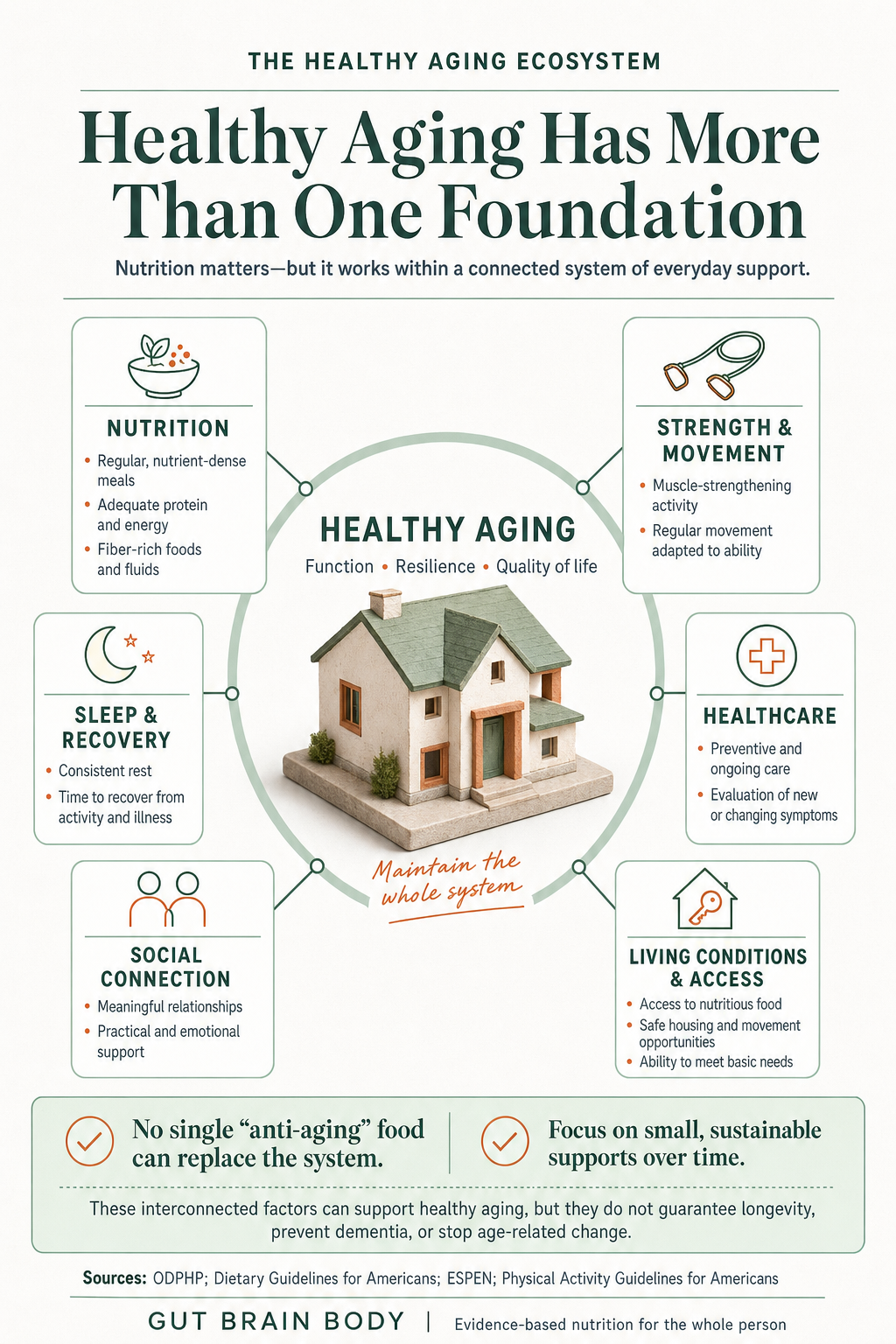
Think of healthy aging more like maintaining a home than buying a lottery ticket. The roof, plumbing, foundation, and electrical system all matter. Nutrition is one important part of the structure, but so are strength, activity, sleep, healthcare, social connection, and the ability to meet your basic needs.
Questions about aging often lead back to the gut, brain, and body:
- Am I eating enough protein to maintain muscle?
- Will fiber help my digestion and microbiome?
- Do fermented foods really reduce inflammation?
- Can a healthier diet support my memory?
- What should I focus on without becoming overwhelmed?
Let’s sort through what we know, what is promising, and what remains more complicated.
What Does Healthy Aging Mean?
Healthy aging is about supporting function, resilience, and quality of life as the years pass.
That can include maintaining strength, mobility, digestion, energy, social connection, and the ability to do the things that matter to you. It also means recognizing that health is influenced by more than food. Access to nutritious meals, safe housing, movement opportunities, medical care, and social support can all shape health later in life. [1]
Nutrition matters because your body still needs building materials. Muscles need protein and energy. The digestive system benefits from adequate fiber and fluids. The brain depends on a steady supply of nutrients and broader support for overall health.
Nutrition works best as part of a larger picture. A balanced eating pattern becomes even more powerful when it is paired with strength training, quality sleep, medical care, and meaningful relationships.
Start With the Overall Eating Pattern
When people are concerned about aging, it is easy to search for the food that will supposedly fix everything: blueberries, olive oil, collagen, mushrooms, kefir, turmeric, or whatever happens to be popular online.
Many foods can fit into a nourishing diet. The more important question is what your eating pattern looks like most of the time.
Generally, you want to emphasize nutrient-dense foods, including vegetables, fruits, protein foods, dairy or fortified alternatives, healthy fats, and whole grains, while limiting foods and beverages high in added sugars, saturated fat, or sodium. [2]
Your meals do not need to be perfect. A much more useful goal is to consistently include enough protein, fiber-rich foods, vitamins, minerals, and energy over time.
Try asking:
- Am I eating regularly enough to meet my energy needs?
- Do I include protein foods consistently?
- Are plants, whole grains, beans, fruits, or vegetables part of my routine?
- Is my diet becoming narrower because of appetite changes, digestive symptoms, busy schedules, or food restrictions?
- Am I relying heavily on convenient foods that leave little room for nutrient-dense choices?
These questions are often more useful than chasing one food or supplement.
Protein and Muscle Health in Older Adults
Muscle loss and declining strength can become more common with age, particularly when food intake, activity, illness, or recovery needs change. Protein provides amino acids that the body uses to maintain and repair tissues.
ESPEN’s practical guideline recommends at least 1.0 gram of protein per kilogram of body weight per day for older adults. It also notes that 1.0 to 1.2 grams per kilogram per day is often suggested for healthy older adults, although needs vary with health status, appetite, illness, activity level, and overall energy intake. [3]
That last point matters: protein does not work in a vacuum.
If overall food intake is too low, meeting protein needs can become difficult. Adequate energy intake is also an important part of supporting muscle maintenance and recovery. [3]
Why Strength Training Matters
Food helps provide raw materials. Muscle-strengthening activity gives your muscles a reason to use them.
A systematic review of community-dwelling adults age 60 and older with sarcopenia suggests that protein supplementation combined with resistance exercise may improve muscle mass and strength. [5] This supports a practical takeaway: adequate protein and regular resistance training can work especially well together.
U.S. physical-activity guidance recommends muscle-strengthening activities on at least two days per week, adapted to your abilities and health conditions. [6]
Strength training might include resistance bands, body-weight exercises, machines, light dumbbells, gardening tasks that genuinely challenge the muscles, or a structured program with a qualified professional. The best form is not necessarily the fanciest. It is the one that is safe, appropriate, and realistic enough to do consistently.
Do You Need Protein Powder?
Protein supplements may modestly support muscle mass in some community-dwelling older adults, particularly when food intake alone does not meet protein needs. [4]
Protein supplements can be very useful when appetite is low, meals are inconsistent, chewing is difficult, or convenience is a major barrier. Timing and dose can be individualized around your overall intake, activity, and preferences. [4]
You do not need to set an alarm for a seven-minute “anabolic window.” Your muscles are not running a tiny airport gate that closes forever if you miss it.
A dietitian or other qualified healthcare professional can help you consider your overall food intake, medical history, activity level, and practical barriers before deciding whether a supplement makes sense.

Can Diet Support Memory and Brain Health?
Some randomized trials suggest that dietary-pattern interventions may modestly improve global cognitive-test scores in older adults. However, the studies are diverse, and the findings do not establish that any dietary pattern prevents dementia or Alzheimer disease. [10]
That distinction matters.
A small improvement on a cognitive test is not the same as proving dementia prevention. It also does not mean diet is irrelevant. Nutrition is one part of overall brain health, alongside physical activity, sleep, cardiovascular health, social connection, medical care, and other factors.
If you are concerned about memory or mood, you can learn more about brain and mood issues. An overall nutrient-dense eating pattern remains a reasonable place to focus, but be cautious about anyone promising that a particular food, supplement, or diet can guarantee protection from cognitive decline.
Practical Healthy Aging Nutrition Steps
You do not need to rebuild your entire kitchen overnight. Start with the areas most likely to make a meaningful difference in your daily routine.
Consider discussing these steps with your healthcare team:
- Look at your overall eating pattern. Aim for regular meals that include vegetables, fruits, protein foods, whole grains, healthy fats, and dairy or fortified alternatives. [2]
- Pay attention to protein intake. Older adults may need more deliberate attention to protein, especially when appetite, illness, activity, or unintentional weight changes have affected food intake. [3]
- Pair nutrition with muscle-strengthening activity. Strength-focused movement on at least two days per week can support muscle health and function when adapted to your needs and abilities. [6]
- Include fiber-rich foods regularly. Fiber can support normal laxation and influence gut microbial activity, although individual responses vary. [3,7]
- Explore fermented foods if they work for you. Yogurt, kefir, kimchi, sauerkraut, miso, and other fermented foods can add variety and may support beneficial microbial changes. [8]
- Use gut-brain research as motivation for strong foundations. Early findings are encouraging, and they reinforce the value of fiber-rich foods, movement, sleep, and overall metabolic health while longer-term research continues. [9,10]
When Measuring Food Can Be Useful
You do not need to weigh every meal to eat well. However, short-term measurement can sometimes help when you are trying to understand how much protein or energy your usual portions provide, especially if a dietitian or other qualified healthcare professional has suggested tracking your intake.
If you choose to use a nutrition scale, look for a clear display, a tare function that subtracts the weight of a bowl or plate, and controls that are easy to operate. Treat app-based nutrient calculations as estimates rather than precise medical data, and avoid tracking if it increases food anxiety or encourages unnecessary restriction.
As an Amazon Associate I earn from qualifying purchases.
The Etekcity ESN00 Smart Nutrition Scale is one practical example for readers who want to measure portions and review estimated nutrition information while building more consistent meals. A tool like this is optional; its value comes from using the information to support a realistic eating routine rather than pursuing perfect numbers.
The best plan is usually the one that meets you where you are. A consistent breakfast with adequate protein may be more useful than an elaborate meal plan you abandon after four days. A regular strength routine may matter more than finding the “perfect” supplement.
When to Seek Professional or Medical Care
Nutrition can be helpful, but it should not replace medical evaluation when symptoms are persistent, disruptive, new, or changing.
Consider speaking with a qualified healthcare professional if you have:
- Ongoing constipation, diarrhea, abdominal pain, or major changes in bowel habits
- Unintended weight loss or difficulty maintaining adequate food intake
- A noticeable decline in strength, mobility, or ability to complete everyday activities
- Reduced appetite that makes it hard to eat enough
- New or worsening memory concerns
- Questions about protein needs, supplements, food restrictions, or a medically complex health history
A thorough evaluation can help identify whether nutrition changes are appropriate and whether other factors need attention.
The Bottom Line
Healthy aging is built from the combination of nourishing food, adequate protein, fiber-rich plants, movement, sleep, and consistent habits that support the gut, brain, and body together.
A nutrient-dense eating pattern, adequate protein and energy intake, regular muscle-strengthening activity, and attention to bowel health are practical foundations that can support the gut, brain, and body over time. [2,3,6]
Fiber and fermented foods are especially promising for supporting gut microbial activity, and dietary-pattern interventions may also support cognitive health in older adults. [7,8,10] These strategies are most useful when they are part of a broader healthy-aging pattern rather than isolated interventions.
At Gut Brain Body, we can help you evaluate digestive symptoms, dietary patterns, protein and fiber intake, and the broader gut-brain-body picture without assuming that one food, one microbe, or one exposure explains everything. To learn more about working together, visit Functional Nutrition Services.
References
- Office of Disease Prevention and Health Promotion. Celebrate Healthy Aging Month with Resources from ODPHP.
- U.S. Department of Health and Human Services and U.S. Department of Agriculture. Dietary Guidelines for Americans, 2025–2030.
- Volkert D, Beck AM, Cederholm T, et al. ESPEN practical guideline: Clinical nutrition and hydration in geriatrics. Clinical Nutrition. 2022.
- Hettiarachchi J, et al. Protein supplementation and muscle mass in community-dwelling older adults: systematic review and meta-analysis. 2024.
- Kim J, et al. Protein supplementation combined with resistance exercise for sarcopenia in community-dwelling older adults: systematic review and meta-analysis. 2024.
- U.S. Department of Health and Human Services. Physical Activity Guidelines for Americans, 2nd edition.
- Chen Y, et al. Dietary-pattern interventions and cognitive function in older adults: systematic review and meta-analysis of randomized trials. 2023.
This article is for educational purposes only and is not a substitute for individualized medical or nutrition advice. Speak with an appropriately qualified healthcare professional before making significant changes to your diet, supplements or treatment plan.